Enterprise AI · Built on Microsoft .NET
AI that works in your actual business
The process owner was never assigned. The integration with the CRM was left as “TBD.” The knowledge base had not been updated in years. The approval path — who confirms what before the agent sends an email or updates a record — was assumed rather than designed. And the business case, which looked clean on a slide, was never instrumented well enough to prove itself to finance.
Most organizations do not fail because the model is weak. They fail because the surrounding operating system is unfinished.
— The Enterprise AI Agent Implementation Playbook
Bayani.AI is built around a simple premise: deploying AI well is a discipline, not a technology purchase. It takes consulting work to scope what to automate first. It takes software engineering to connect agents to systems that were built before AI existed. It takes governance design to decide where a human must remain in the loop. And it takes measurement infrastructure to prove, in numbers finance actually accepts, that value was created.
We do all four. In one team. For the full project.
The real problem with enterprise AI is not the AI
Most teams debug the wrong layer first. They swap models, tweak prompts, and benchmark response style while the actual failure is already locked into the index.
— Data Quality for RAG: The Foundation of Accuracy
What Bayani.AI actually delivers
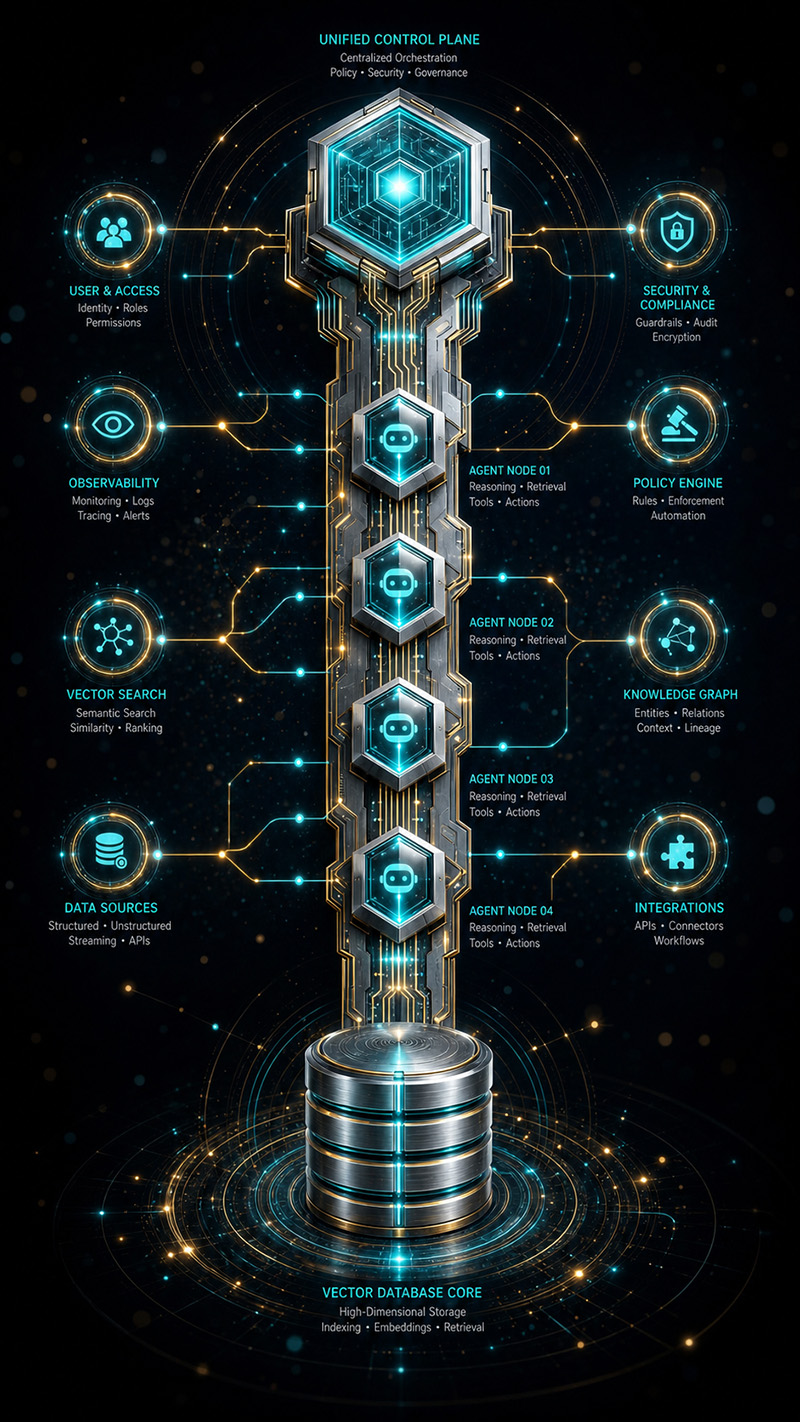
We work across three service lines that are deliberately kept inside one team: AI consulting and implementation strategy, custom software development on Microsoft .NET, and IT infrastructure management. The reason is not a sales-bundling decision — it is that these three things are genuinely inseparable in a live deployment. The architecture is a consulting output. The implementation is constrained by the infrastructure. The infrastructure has to reflect the governance decisions made in consulting. Handing off between three vendors is how projects stall.
The agents we build are grounded in your knowledge — indexed using Retrieval-Augmented Generation so that every answer traces back to a real document in your approved content base, not to whatever a language model learned before you became a customer. They carry persistent memory per user and per organization, so they become more useful over time without model retraining. And they connect to external systems through the Model Context Protocol — the standard interface that lets a single agent call your CRM, your calendar, your document storage, and your task manager without a bespoke integration for each one.
The AI shouldn’t just answer; it should do research first to determine which of the answers are the best.
— Jensen Huang, CEO, Nvidia
And critically: every action the agent proposes that touches a real system — sending a message, updating a record, booking a meeting, dispatching a document — requires a human to confirm it before it executes. This is not a limitation we plan to remove once trust is established. It is a design decision that is permanent by principle. The agent does the heavy lifting. The human makes the call. Every confirmed action is logged, timestamped, and attributed to the person who approved it.
Built on leading AI & cloud platforms
 Azure AI
 OpenAI
 Copilot Studio
 .NET
.NET AI Search
 Cosmos DB
 AI Foundry
 MCP
MCP Qdrant
How we build
Six decisions we made before writing a line of code
Every platform has an implicit philosophy. These are ours — explicit, reasoned, and not subject to renegotiation for the sake of a faster demo.
Human confirmation on every persistent action
No agent sends a message, updates a record, books a meeting, or modifies shared data without explicit human confirmation. The agent proposes; the human approves, edits, or cancels. Every confirmed action is logged with a timestamp and the identity of who approved it.
Every answer is traceable to a source
Agents do not answer from the model’s parametric memory. They retrieve relevant sections of your approved knowledge base, ground the response in that content, and surface the source document alongside the answer. Users can verify. Auditors can verify.
Your data never leaves your environment
Everything runs on dedicated Azure infrastructure. Multi-tenancy means hard data isolation — a separate index, scoped memory, and access-controlled retrieval per organization. Your knowledge base never co-mingles with another customer’s.
Deployed where your teams already work
Reach agents through the Bayani portal, embedded on your public website, on your internal intranet, or via the Bayani API for custom integrations. For organisations using Microsoft Entra ID, agents can also surface directly inside Microsoft 365 Copilot. The same agent, knowledge base, and governance model — whichever channel you use.
Governance built in, not bolted on
Compliance has to be architectural. Every deployment ships with full audit logging, role-based access control, per-tenant memory scoping, least-privilege tool permissions, and backend-proxied external calls. The governance layer is what makes the system safe to scale.
One team for the full project
We do not separate consulting from implementation from infrastructure. The architecture is a consulting output; the implementation is constrained by the infrastructure; the governance design has to be reflected in the software. One team, one engagement, no handoff friction.
Industries
Sectors we serve
AI that understands the compliance, data sensitivity, and workflow constraints that vary by industry.
 Health & Medicine
Clinical documentation, patient triage support, medical knowledge bases
Health & Medicine
Clinical documentation, patient triage support, medical knowledge bases Finance
Document processing, compliance automation, intelligent reporting
Finance
Document processing, compliance automation, intelligent reporting SaaS & Tech
AI feature integration, knowledge bases, customer support agents
SaaS & Tech
AI feature integration, knowledge bases, customer support agents Manufacturing
Process automation, quality control AI, operational intelligence
Manufacturing
Process automation, quality control AI, operational intelligenceInsights
From the Bayani.AI team
Knowledge Assistants & AI Co-Pilots — The New Intelligence Layer
How organizations turn scattered documentation into a reliable intelligence layer that employees and customers can actually use.
Global AI Compliance: Navigating a Complex Landscape
A practical view of how delivery teams satisfy overlapping AI regulations without rebuilding their stack for each jurisdiction.
Text-to-SQL in Production: Making Natural Language Data Access Safe
What it takes to move from impressive demos to governed data access with schema-aware generation, review gates, and auditability.
Bayani
Bayani comes from bayan — a community, a nation, a shared purpose. It speaks to a kind of heroism that is collective, not individual.
Today, a bayani is anyone who shows up, builds, contributes, and moves others forward. It is not about titles or recognition — it is about impact. In every small action that uplifts the whole, the spirit of bayani lives on.
Our technology stack
.NET C#
Azure AI
AI Foundry
Azure AI Search
Cosmos DB
Qdrant
Copilot Studio
MCP
C#
Azure AI
AI Foundry
Azure AI Search
Cosmos DB
Qdrant
Copilot Studio
MCP Blazor
 Tailwind CSS
The organizations seeing results today are the ones that started building last year — not because they had better AI, but because they had more production hours logged against real problems.
— Bayani.AI, The Enterprise AI Agent Implementation Playbook
Ready to ship a working AI solution?
Partner with Bayani.AI to unlock the full potential of AI and IT for your enterprise. We start with a scoping call — no commitment required.